
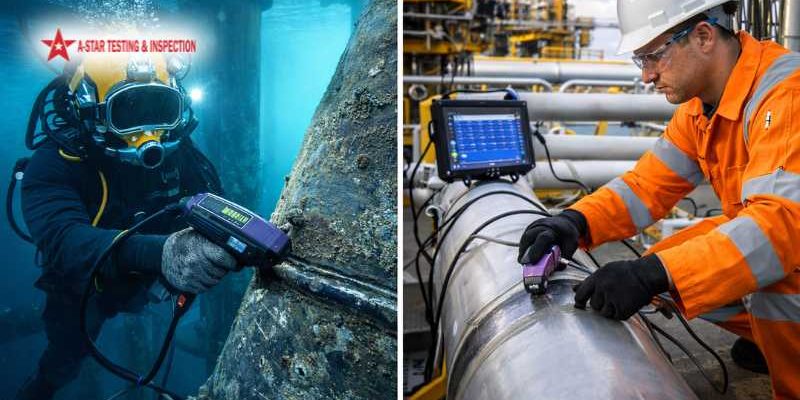
In the demanding world of asset integrity, detecting fatigue cracks before they lead to structural failure is a constant challenge. Alternating Current Field Measurement (ACFM) inspection for underwater and above-ground applications has emerged as an industry-leading electromagnetic NDT technique.
Unlike traditional methods that require extensive surface cleaning, ACFM allows inspectors to detect and size surface-breaking cracks through coatings, paint, and even marine growth. This versatility makes ACFM inspection services indispensable for offshore platforms, marine vessels, and heavy industrial onshore assets where downtime must be kept to an absolute minimum.
What Is Alternating Current Field Measurement (ACFM)?
ACFM is a non-destructive testing (NDT) technique that is advanced electromagnetically. Its principle is to stimulate an alternating current on the surface of a material and record the corresponding disruptions in the magnetic field. With a crack, current will be redirected, forming a signature, which the ACFM probe measures.
Reasons why ACFM testing services are the best compared to the traditional NDT:
- No Coating Removal: Examine several millimeters of epoxy paint.
- Quantitative Data: Proposes accurate crack depth and length measurement in real time.
- Digital Traceability: Produces a digital record of the audit to be used in the audit.
- Flexibility: Can be used successfully in high-pressure subsea and industrial conditions on the topside.
ACFM Inspection for Underwater Structures
In the case of the marine and offshore industry, underwater ACFM inspection is a game-changer. Conventionally, such magnetic Particle Inspection (MPI) required the Divers or Remotely Operated Vehicles (ROVs) to grind welds down to bare metal. ACFM eliminates this need.
Typical Subsea Applications:
- Offshore Platform Jacket Inspection: Fatigue (wave loading) structural welds monitoring.
- FPSO Hull Integrity: Visiting the moonpools and submerged areas of welding.
- Subsea Pipeline Weld Crack Detection: The assessment of girth welds on working pipelines.
- Jetty and Marine Infrastructure: Determining the health of steel piles and quay walls in high salinity areas.
Through marine ACFM inspection services, operators are able to achieve extensive in-water survey that has been subjected to the stringent requirements of the classification societies without necessarily dry-docking.
ACFM Inspection for Above-Ground & Topside Assets
Above-ground ACFM inspection services are offered onshore and on top of the ground to offer a quick screening mechanism of the critical process equipment. It does not need surface preparation, hence making it much faster than the conventional dye penetrant or eddy current testing.
Common Onshore and Topside Applications:
- Topside ACFM Inspection: Assessment of offshore rig deck structures, flare booms, and crane pedestals.
- Pressure Vessel and Storage Tank Inspection: The identification of stress corrosion cracking (SCC) in the nozzles and shell welds.
- Refinery Pipeline Weld Inspection: High temperature fatigue monitoring.
- Crack Detection of Structural Steel: Structural steel skeletons, bridges, and cranes.
Key Benefits of ACFM Inspection Services
- High Probability of Detection (PoD): outstanding regarding the discovery of fatigue cracks, which could be missed in other techniques.
- Precision in Sizing: As compared to MPI, which merely indicates the presence of a crack, ACFM indicates to you how deep the crack is.
- Lower Cost: Necessity of doing away with grit blasting or chemical cleaning saves thousands of money in labor and material expenses.
- Operational Safety: Is applicable to “live” conditions where no grinding is allowed or surface prep that generates sparks.
Compliance and Industry Standards
Professional non-destructive testing of ACFM has to be carried out by certified professionals in order to achieve engineering grade results. Our services at A-Star are in accordance with:
- ACFM certified ACFM inspectors (ASNT, Level 2-3).
- Quality management systems of NDT that are certified by ISO.
- IACS and API on offshore and marine asset integrity.
FAQs: ACFM Inspection for Underwater and Above-Ground
Q1: Does ACFM have the ability to identify cracks under dense marine vegetation?
Ans: Yes. ACFM inspection is much faster than other NDT techniques, whereas the heavy growth should be cleared to facilitate probe contact, and the white metal finish required by other techniques is unnecessary with underwater ACFM.
Q2: Compare ACFM to Magnetic Particle Inspection (MPI)?
Ans: MPI is a go/no-go test which necessitates bare metal. ACFM operates by finishes and offers a computerized history of the depth of the crack, which is essential to fitness-for-service (FFS) evaluation.
Q3: Does ACFM work on any metals?
Ans: ACFM is mainly suitable in conductive material i.e., carbon steel, as well as stainless steel and other alloys used in pipelines and pressure vessels.
Q4: Is it possible to conduct high-temperature inspections with ACFM?
Ans: Yes. Topside ACFM can also be done on in-service assets at high temperatures using specialized probes.
Conclusion: Precision Integrity Management
Alternating Current Field Measurement (ACFM) inspection of underwater and air structures is the new gold standard of inspecting cracks. ACFM enables the industrial and offshore operators to uphold the highest safety standards as much as possible and gives them real time, precise sizing information without having to prepare their surfaces in advance.
Protect your critical infrastructure from the invisible threat of fatigue.
Call A-Star Testing & Inspection and see how we can help with our certified ACFM inspection services on your next subsea or topside project.